


How to Remove Japanese Knotweed in Your Home
Finding Japanese knotweed in your garden is the sort of thing that can ruin an otherwise peaceful Saturday morning. One minute you're enjoying a cup of tea, and the next you're staring at a plant that could complicate a house sale, upset the neighbours, or quietly start causing damage beneath your patio.
That might sound dramatic, but Japanese knotweed is one of the few garden problems in the UK that comes with genuine legal and financial implications, not just a bit of gardening frustration. The real issue is how easily it spreads when handled incorrectly. Without the right approach, attempts to remove it can actually make the infestation worse. This is why it is crucial to understand how to remove Japanese knotweed and explore the knotweed treatment options before you take any action.
What Japanese Knotweed Actually Looks Like
Before you panic, it's worth knowing that Japanese knotweed is often mistaken for other plants. Russian vine, Himalayan honeysuckle, and some Persicaria species regularly get confused with it, so proper knotweed identification matters. If you are struggling to identify the plant please get in contact with our team with a photo and we can help identify it for you.
Here's what to look out for throughout the year:
Spring
Reddish-purple shoots emerging from the ground
Fast-growing, asparagus-like spears that quickly turn into stems
Summer
Hollow, bamboo-like stems with purple speckles and noticeable joints
Growth can reach over 2 metres tall by midsummer
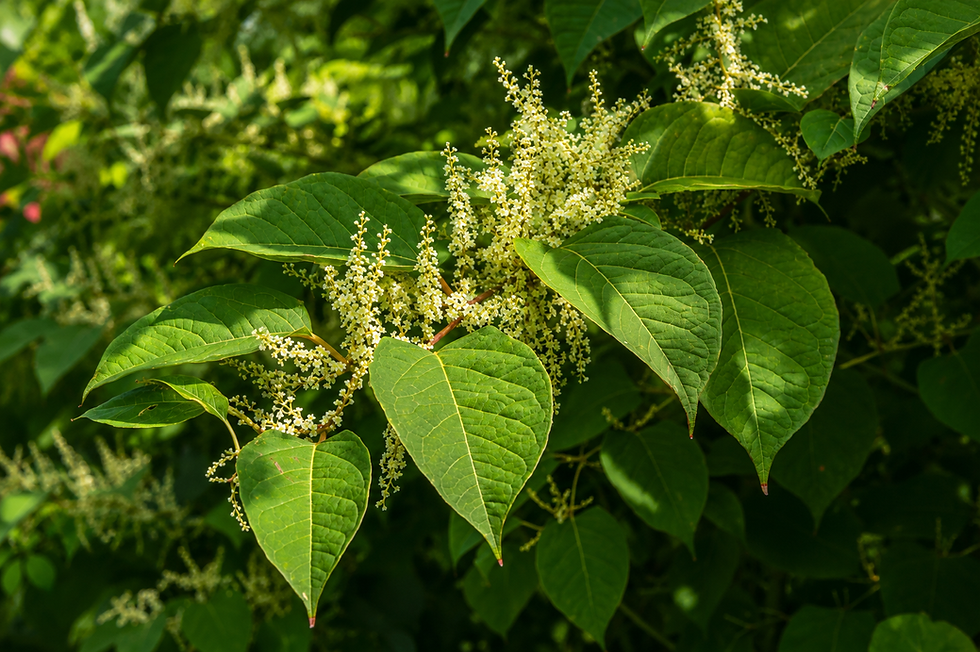
Large heart-shaped leaves with a flat base, arranged in a zig-zag pattern along the stem
Late Summer
Clusters of small creamy-white flowers near the ends of the stems
Winter
Brown dead stems that may remain standing or collapse onto the ground
Although the visible growth dies back, the underground root system stays alive and ready to regrow in spring
If you're not completely sure what you're dealing with, avoid digging or cutting it back straight away. Misidentifying the plant can waste time, money, and often creates more problems than it solves. A few clear photos and advice from a specialist can save a lot of stress later on. Get in touch with our specialist here.
What's Happening Underground
The real problem with Japanese knotweed lies below the surface. Underground, the plant develops a dense network of rhizomes, which are thick, woody root-like structures that spread aggressively through the soil.
These rhizomes can grow more than a metre deep and several metres outward from the visible plant. If you cut one open, you'll usually see a bright orange centre beneath a dark brown outer layer, which is often a useful clue during identification.
This underground spread is exactly why knotweed is so difficult to remove. Even a tiny fragment of rhizome, sometimes as small as 1cm, can grow into a completely new plant. That's why disturbing it without a proper treatment plan can quickly turn a small issue into a much larger one. Trying to remove Japanese knotweed yourself can cause these fragments to spread and cause further infestation, which is why we suggest speaking to a specialist about how to remove your Japanese knotweed.
Is Japanese Knotweed Illegal?
Not exactly, but the rules around it are more complicated than many people realise.
Simply having Japanese knotweed on your property is not illegal. You're not automatically required to remove it unless it begins spreading beyond your boundary or starts causing a nuisance to neighbouring landowners.
However, if it spreads into the wild or onto nearby properties, you could face legal consequences. Under the Anti-Social Behaviour, Crime and Policing Act 2014, local authorities can require landowners to control the plant if it's having a persistent negative impact on nearby residents.
Japanese knotweed is also listed under Schedule 9 of the Wildlife and Countryside Act 1981, which makes it an offence to plant it or knowingly allow it to spread into the wild.
So while owning it isn't illegal, ignoring it completely can become a serious problem. Our FAQ page covers many of the most common legal and practical questions homeowners ask.
What This Means When Selling Your Home
This is usually where knotweed stops being "just a garden issue." Since 2013, sellers in England and Wales have been required to declare the presence of Japanese knotweed on the TA6 Property Information Form during conveyancing. Failing to disclose it properly can lead to disputes or legal claims after the sale completes. Our dedicated page on selling a house with Japanese knotweed covers this process in full.
If You're Selling
Inspect your garden carefully, especially during winter when knotweed dies back and becomes harder to spot
The TA6 form asks whether knotweed is present and whether there's a treatment plan in place
Buyers and mortgage lenders will usually expect to see a professional management programme with an insurance-backed guarantee
If You're Buying
Read the TA6 responses carefully
Ask for copies of any treatment plans and guarantees
Some mortgage lenders may refuse to release funds without evidence that the issue is being professionally managed
Knotweed doesn't automatically stop a property sale, but it can absolutely delay things if there isn't a clear treatment plan in place. Our page on Japanese knotweed survey requirements explains what lenders and surveyors typically need to see.
Professional Japanese Knotweed Treatment Options
There's no instant miracle cure for Japanese knotweed, despite what some contractors might claim. Proper treatment takes time, experience, and the right approach for the site conditions.
The good news is that there are several proven treatment methods available, depending on the size of the infestation, the surrounding environment, and future plans for the property or land. You can explore all of these on our knotweed treatment options page.
Chemical Treatment Treatment period: 24 to 48 months
Chemical treatment is one of the most widely used and cost-effective ways of controlling Japanese knotweed. Special herbicides are applied over two to four growing seasons to gradually weaken and kill the underground rhizome system.
Depending on the size of the infestation, the season, and site conditions, treatment may involve stem injection, root injection, cut stem treatment, or targeted spraying.
This type of treatment should always be carried out by fully qualified and experienced specialists. While it's often the most affordable option, it does require patience and ongoing monitoring to ensure the knotweed is fully controlled.
It's also worth being cautious of contractors who promise complete eradication within a single growing season. Professional bodies and industry regulators consistently warn against unrealistic claims like these. At present, there are no commercially available herbicides capable of eliminating mature Japanese knotweed in just one season.
In some cases, herbicide treatment periods can be shortened by combining chemical treatment with other methods that help disrupt the rhizome system more aggressively.
Organic Treatment Treatment period: 12 to 18 months
Organic treatment methods are becoming increasingly popular, particularly on environmentally sensitive sites or in areas where nearby plants and wildlife need protecting.
This approach is especially useful on commercial sites and around water treatment areas, ecological sites, and landscaped environments with protected planting.
Individual plants are treated using a specialist electrical treatment process that targets invasive species such as Japanese knotweed, Giant Hogweed, Himalayan Balsam, and Rhododendron.
Over the past few years, this treatment has become a preferred option for many developers and local authorities looking for a more environmentally conscious solution.
Bunds and Herbicide Treatment period: 24 to 48 months
On larger development sites, knotweed-infested soil can sometimes be relocated into specially constructed treatment bunds. This allows affected areas to be cleared for development while the contaminated material remains safely contained elsewhere on-site as part of a long-term herbicide treatment programme. Find out more about our cell burial and bund barrier membrane solutions.
It's a practical option on commercial or redevelopment projects where keeping work moving is a priority.
Minimal Dig and Herbicide Treatment period: 12 to 24 months
This method combines excavation with targeted herbicide treatment. The most aggressive and difficult-to-treat areas of growth are removed first, while the remaining material is dealt with using soil screening techniques and professional herbicide applications.
It's often a good middle-ground solution where full excavation isn't necessary but quicker progress is needed.
Capping Treatment period: Instant
Capping involves encapsulating Japanese knotweed beneath a specialist root barrier membrane. These membranes are extremely durable and designed to resist punctures, tears, and root penetration. Once installed correctly, they prevent the knotweed from spreading into surrounding areas. Our cell burial and bund barrier membrane page covers this option in more detail.
In many situations, capping can provide an immediate solution, particularly on development sites where excavation may not be practical.
On-Site Burial Treatment period: Instant
On-site burial is another method that can provide immediate eradication. This involves excavating the knotweed and burying the contaminated material within a specially designed burial cell on the site itself.
It's typically most suitable for car parks, public open spaces, and areas where deep future groundworks are not planned. When carried out correctly, this approach keeps contaminated waste safely contained without needing to transport it elsewhere.
Screening, Sorting and Incineration
For some heavily contaminated sites, soil screening, soil sorting, and controlled incineration may be used as part of a wider remediation strategy. These methods are generally reserved for large commercial projects or sites where rapid redevelopment is required.
Save Our Soil (S.O.S.) ScreeningTreatment period: Variable depending on site
Save Our Soil (S.O.S.) is an innovative soil screening methodology developed by Japanese Knotweed Control Ltd that offers a more sustainable and cost-effective alternative to traditional excavation and off-site disposal.
Rather than removing and transporting large volumes of contaminated soil to landfill, the S.O.S. system processes the soil on-site through specialist machinery and screening mesh. This separates knotweed rhizomes and plant material from the surrounding soil, leaving clean material that can be reused directly on-site for landscaping and other purposes.
Where ground conditions allow, S.O.S. screening can reduce the volume of material requiring off-site disposal by up to 95%, resulting in significant savings on transport and waste disposal costs.
The process begins with a comprehensive site assessment, which can include drone surveys, sniffer dog detection, and GPS mapping to precisely identify the extent of contamination. Soil analysis then determines rhizome depth, density, and distribution before controlled excavation and screening begins.
S.O.S. is particularly well suited to:
Large development or commercial sites where disposal costs would otherwise be substantial
Sites where preserving existing soil and reducing imported fill material is a priority
Projects with environmental or biosecurity requirements
Sites where minimising carbon footprint and transportation emissions is important
By retaining and treating soil locally, the S.O.S. method helps protect surrounding ecosystems, maintain soil structure, and keep project timelines moving efficiently. All screened material is monitored and mapped, with follow-up inspections carried out in subsequent seasons to confirm that no viable rhizome material has escaped the screening process.

Common Mistakes That Make Knotweed Worse
Some mistakes are incredibly common, and unfortunately they often spread the problem further.
Avoid:
Rotavating or strimming through knotweed, which spreads rhizome fragments through the soil
Skipping treatment seasons and allowing the plant to recover
Moving contaminated soil off-site illegally — our excavation and disposal service handles this correctly under environmental regulations
Putting live knotweed into compost bins or green waste collections
Ignoring it altogether is another major mistake. Knotweed spreads steadily underground each year, and what starts in one corner of the garden can eventually reach patios, drains, fences, and neighbouring properties.
Japanese Knotweed Near Your House
Japanese knotweed doesn't usually smash through solid concrete foundations, despite some of the horror stories online. What it does do very well is exploit existing weaknesses. It can grow through cracks in paving, weak points in tarmac, loose joints in masonry, and existing drainage defects. Older or poorly maintained structures tend to be more vulnerable.
If knotweed is growing close to your property, it's sensible to arrange a professional Japanese knotweed survey early on so you understand exactly what you're dealing with.
Talking to Your Neighbours About Knotweed
If the knotweed appears to be spreading from a neighbouring property, it's usually best to start with a calm conversation before escalating things formally. In many cases, neighbours are already aware of the issue and may even be arranging treatment themselves. A straightforward conversation often solves far more than people expect.


Comments