


Spanish Bluebell - Invasive Species Information

Reproduction: Spanish bluebell's seed freely and often hybridize through insect polination.
The Spanish bluebell has hybridised frequently with the native common bluebell and the resulting hybrids are regarded as invasive.

Spanish Bluebell Flowers
The resulting hybrid Hyacinthoides × massartiana and the Spanish bluebell both produce highly fertile seed but it is generally the hybrid that invades areas of the native common bluebell. This has caused the common bluebell to be viewed as a threatened species.

Spanish Bluebell
Hyacinthoides hispanica
Common Bluebell
Hyacinthoides non-scripta
Spanish & Common Bluebell Identification
Spanish Bluebell is distinguished from the common bluebell by its paler and larger blue flowers, which are less pendulous and not all drooping to one side like the common bluebell; plus a more erect flower stem (raceme), broader leaves, blue anthers (where the common bluebell has creamy-white ones) and little or no scent compared to the strong fragrant scent of the northern species.
Like Hyacinthoides non-scripta, both pink and white flowered forms occur.
How To Identify Spanish Bluebell?
Leaf: Broad green leaf
Flower: Pale or dark blue
Stem: Green upright & tubular
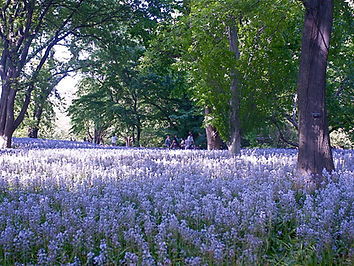
Spanish Bluebell - Hyacinthoides hispanica ID Guide

Spanish Bluebell - Hyacinthoides hispanica ID Guide
Spanish Bluebell Woodland Stand
Why Is Spanish Bluebell A Problem?
The larger Spanish bluebell can become a problem, not just because of its spreading habit, but also due to its ability to hybridise with the native form. The hybrid forms displace the natives.
As well as the threat of extinction, Spanish bluebells pose to native bluebells, their spread also have knock-on effects for other species.
Native plants and animals evolve together, forming close dependencies and relationships which break down when one is removed or replaced.
The preservation of native plants and animals is crucial to maintaining the variety of life that make Ireland's woodlands and wild places so rich and diverse.
What Is Spanish Bluebell - (Hyacinthoides hispanica)?
Habitat: Terrestrial. Commonly found in woodland
Distribution in Ireland: Abundant in woodland and gardens nationwide.
Status: Established
Family name: Asparagaceae
European Communities (Birds and Natural Habitats) Regulations 2011 non-native invasive plant species A-Z (Updated 2017)
There are currently 35 invasive plant species listed in the European Communities (Birds and Natural Habitats) Regulations (annex 2, Part 1)...
Click on a species from the following list to find out more regarding non-native species subject to restrictions under Regulations 49 and 50.
-
American Skunk-Cabbage - Lysichiton americanus
-
Red Alga - Grateloupia doryphora
-
Waterweeds - Elodea (all species)