


Wireweed - Invasive Species Information

Reproduction: Both sexual and asexual. Reaches sexual maturity in the summer.
The species is monoecious, meaning an individual is capable of producing male and female gametes. Its cycle of development is monogenic (i.e. only one generation is present during its life cycle).

Wireweed - Sargassum muticum
At the level of fertilization: male gametes are dispersed in seawater while female gametes remain in the receptacle where fertilization takes place.
Development is also done at the receptacle and then once at the stage of seedling, the latter is detached for fixation on a new support and form a new individual. This species can also reproduce asexually. But this has never been observed in temperate environments.
Wireweed is composed of two distinct parts:
-
a perennial part, which contains the holdfast and one or more short main axes;
-
an annual part: the secondary axes, which develop on the main axis, whose growth is unlimited and the size is variable.
There are three types of ramifications: laterals with foliaceous expansions called fronds, laterals with fronds and aerocysts and laterals with fronds, aerocysts and reproductive organs called receptacles.
In winter, only the perennial part persists (5 cm). In summer, the lateral part is in maximum development of 2–3 meters up to 10 meters.
How To Identify Wireweed?
Frond: Green/Brown
felty, fibrous discoid holdfast up to 1.5 cm in diameter
Blades: linear-lanceolate on the basal portion of stipe, to 10 cm long, toothed with the upper stipe narrow, often only 4 mm long
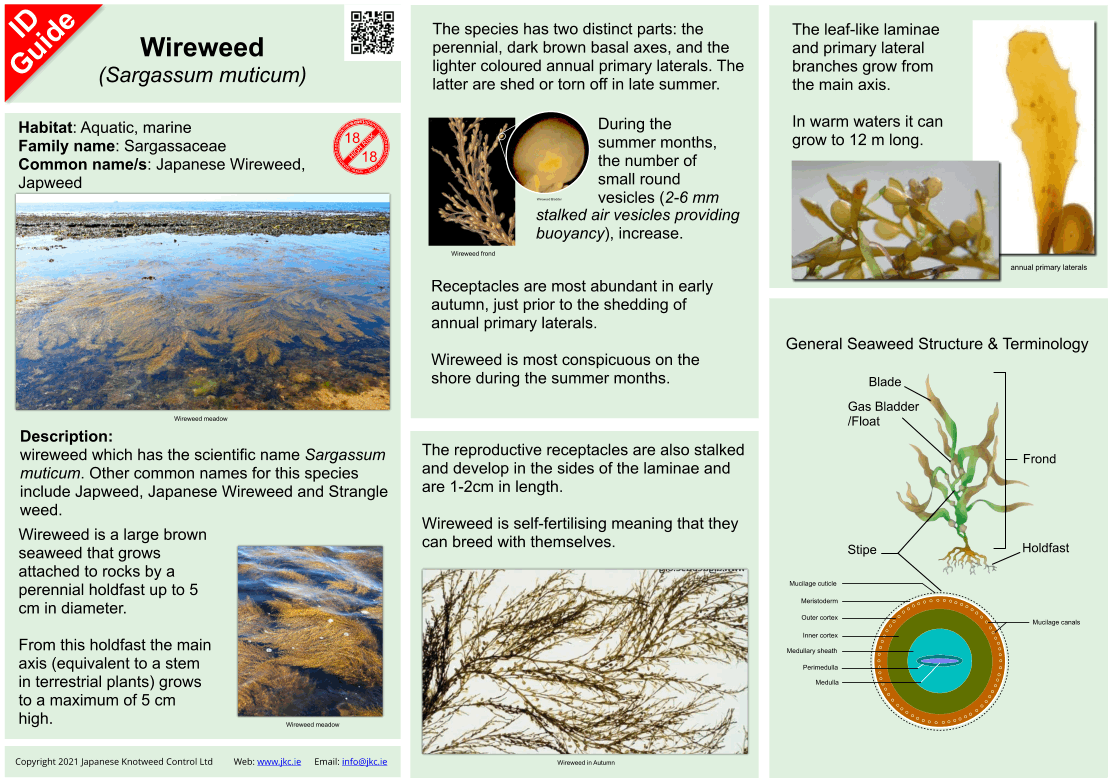

Wireweed - Sargassum muticum ID Guide
Wireweed - Sargassum muticum
Why Is Wireweed A Problem?
Wireweed's proliferation is significant, especially during the summer, which causes economical and ecological problems.
Ecological: Because of its large size and dense ramifications, Wireweed forms a screen within the water column preventing the penetration of light.
It also captures the nutrients depriving availability to other species such as phytoplankton. However, can also serves as shelter and protection for fish larva or crustaceans as well as laying support for cuttlefish.
Economical: Fixes itself to the shells of oysters creating problems in shellfish farming through increased manual work to eliminate the algae.
In addition, it can wrap around farming structures, requiring additional maintenance. It also gets entangled with the propellers of the boats.
What Is Wireweed - (Sargassum muticum)?
Habitat: Aquatic, marine
Distribution in Ireland: Abundant coastal areas
Status: Established
Family name: Sargassaceae
European Communities (Birds and Natural Habitats) Regulations 2011 non-native invasive plant species A-Z (Updated 2017)
There are currently 35 invasive plant species listed in the European Communities (Birds and Natural Habitats) Regulations (annex 2, Part 1)...
Click on a species from the following list to find out more regarding non-native species subject to restrictions under Regulations 49 and 50.
-
American Skunk-Cabbage - Lysichiton americanus
-
Brazilian Giant-Rhubarb - Gunnera manicata
-
Broad-Leaved Rush - Juncus planifolius
-
Cape Pondweed - Aponogeton distachyos
-
Cord-Grasses - Spartina (all species and hybrids)
-
Curly Waterweed - Lagarosiphon major
-
Dwarf Eel-Grass - Zostera japonica
-
Fanwort - Cabomba caroliniana
-
Floating Pennywort - Hydrocotyle ranunculoides
-
Fringed Water-Lily - Nymphoides peltata
-
Giant Hogweed - Heracleum mantegazzianum
-
Giant Knotweed - Fallopia sachalinensis
-
Giant-Rhubarb - Gunnera tinctoria
-
Giant Salvinia - Salvinia molesta
-
Himalayan Balsam - Impatiens glandulifera
-
Himalayan Knotweed - Persicaria wallichii
-
Hottentot-Fig - Carpobrotus edulis
-
Japanese Knotweed - Fallopia japonica
-
Large-Flowered Waterweed - Egeria densa
-
Mile-a-Minute Weed - Persicaria perfoliata
-
New Zealand Pigmyweed - Crassula helmsii
-
Parrots Feather - Myriophyllum aquaticum
-
Red Alga - Grateloupia doryphora
-
Rhododendron - Rhododendron ponticum
-
Salmonberry - Rubus spectabilis
-
Sea-Buckthorn - Hippophae rhamnoides
-
Spanish Bluebell - Hyacinthoides hispanica
-
Three-Cornered Leek - Allium triquetrum
-
Wakame - Undaria pinnatifida
-
Water Chestnut - Trapa natans
-
Water Fern - Azolla filiculoides
-
Water Lettuce - Pistia stratiotes
-
Water-Primrose - Ludwigia (all species)
-
Waterweeds - Elodea (all species)
-
Wireweed - Sargassum muticum