


Chilean Rhubarb - Invasive Species Information

What Is Chilean Rhubarb - (Gunnera tinctoria)?
Habitat: Shade tolerant, prefers damp soil.
Distribution in Ireland: Western Ireland
Status: Established
Family name: Gunneraceae
Common Name/s: Giant Rhubarb
birds, water and human activity such as the transport and movement of soil containing the seeds.

Reproduction: reproduce by both sexual (seed) and asexual (vegetative) means. Each mature plant is capable of producing up to 250,000 drupe-like seeds every year which are then distributed by

Chilean Rhubarb can also regenerate from root fragments, leaf cuttings and rhizomes. Once a small fragment of rhizome becomes established, it can extend by 15cm a year. Please note, that breaking the rhizome may result in the creation of more plants.
Giant Rhubarb Seeds
Chilean Rhubarb Leaf
Chilean Rhubarb is a large perennial plant which is native to Chile and Argentina in South America. It was first introduced to Ireland in the 1800s as an ornamental garden plant because of its size and exotic appearance. Since then, it has escaped into the wild and is now particularly invasive along the western coast.
How To Identify Chilean Rhubarb?
Leaf: Very Large Dark Green Leaf
Seeds: Green/Orange
Size: Can grow to 3 metres high and 4 metres wide
Stem, weak spines on stem and under leaf
Chilean Rhubarb is shade tolerant so it may colonise in a variety of landscapes.
The dense stands of Chilean Rhubarb can render large areas unsuitable for agricultural or amenity purposes.

Chilean Rhubarb - Gunnera tinctoria ID Guide
The species can invade native grassland and subsequently reduce the value of the land for grazing.
Why Is Chilean Rhubarb A Problem?
Chilean Rhubarb threatens indigenous biodiversity. Once established, it can quickly develop large and dense colonies which prevent native plants from growing underneath them.
Chilean Rhubarb is an invasive species which can seriously effect drainage and water run-off, leading to increase flood risks.
Small fragments of plant material may be spread unintentionally on shoes and clothes.
As the plant is capable of regeneration from small pieces of rhizome, all material must be handled and disposed of in a way which does not result in the potential for further spread.
Management, Control and eradication requires continued input and follow-up over a number of years to deal with re-growth and subsequent seedling germination.
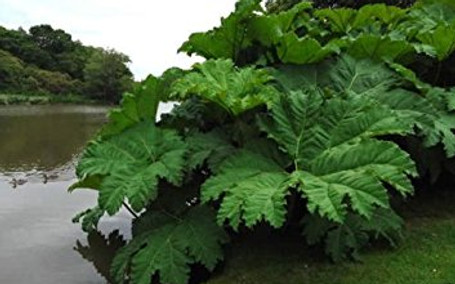
Giant Rhubarb - Gunnera tinctoria
It is recommended that any attempt to control Chilean Rhubarb should be carried out by trained and experienced personnel.
Non-Native Plant Species identified as High Risk on Ireland's Biodiversity List...
Common name
Species name
Environment
Terrestrial
Freshwater
Terrestrial
Terrestrial
Marine
Freshwater
Freshwater
Freshwater
Terrestrial
Terrestrial
Terrestrial
Terrestrial
Marine
Terrestrial
Freshwater
Freshwater
Freshwater
Terrestrial
Freshwater
Marine
Risk score
20
19
18
19
18
19
21
20
19
18
18
19
19
20
20
19
20
20
20
18
European Communities (Birds and Natural Habitats) Regulations 2011 non-native invasive plant species A-Z (Updated 2017)
There are currently 35 invasive plant species listed in the European Communities (Birds and Natural Habitats) Regulations (annex 2, Part 1)...
Click on a species from the following list to find out more regarding non-native species subject to restrictions under Regulations 49 and 50.
-
American Skunk-Cabbage - Lysichiton americanus
-
Brazilian Giant-Rhubarb - Gunnera manicata
-
Broad-Leaved Rush - Juncus planifolius
-
Cape Pondweed - Aponogeton distachyos
-
Cord-Grasses - Spartina (all species and hybrids)
-
Curly Waterweed - Lagarosiphon major
-
Dwarf Eel-Grass - Zostera japonica
-
Fanwort - Cabomba caroliniana
-
Floating Pennywort - Hydrocotyle ranunculoides
-
Fringed Water-Lily - Nymphoides peltata
-
Giant Hogweed - Heracleum mantegazzianum
-
Giant Knotweed - Fallopia sachalinensis
-
Giant-Rhubarb - Gunnera tinctoria
-
Giant Salvinia - Salvinia molesta
-
Himalayan Balsam - Impatiens glandulifera
-
Himalayan Knotweed - Persicaria wallichii
-
Hottentot-Fig - Carpobrotus edulis
-
Japanese Knotweed - Fallopia japonica
-
Large-Flowered Waterweed - Egeria densa
-
Mile-a-Minute Weed - Persicaria perfoliata
-
New Zealand Pigmyweed - Crassula helmsii
-
Parrots Feather - Myriophyllum aquaticum
-
Red Alga - Grateloupia doryphora
-
Rhododendron - Rhododendron ponticum
-
Salmonberry - Rubus spectabilis
-
Sea-Buckthorn - Hippophae rhamnoides
-
Spanish Bluebell - Hyacinthoides hispanica
-
Three-Cornered Leek - Allium triquetrum
-
Wakame - Undaria pinnatifida
-
Water Chestnut - Trapa natans
-
Water Fern - Azolla filiculoides
-
Water Lettuce - Pistia stratiotes
-
Water-Primrose - Ludwigia (all species)
-
Waterweeds - Elodea (all species)
-
Wireweed - Sargassum muticum